Parsing PDFs Without Losing Their Structure
PDFs are convenient for publishing product catalogs, installation guides, compliance documents, invoices, and technical manuals. They are much less convenient for retrieval systems. A parser


PDFs are convenient for publishing product catalogs, installation guides, compliance documents, invoices, and technical manuals. They are much less convenient for retrieval systems. A parser

“Customers Who Viewed This Also Viewed” is an item-to-item recommendation pattern for WooCommerce product pages. Instead of asking which products are generally popular, it asks
For a WooCommerce search experience, few settings have as much influence as searchableAttributes. This setting tells Algolia which product fields can match a query and,

For WooCommerce projects, “AI chatbot” and “RAG” are often discussed as competing technologies. They are not the same thing. An AI chatbot is the customer-facing

Choosing between WPSOLR and FiboSearch depends primarily on search scope, infrastructure, catalog size, and how much control an agency needs over indexing and relevance. Both

On many WooCommerce stores, shoppers who use search are among the most valuable visitors. They have already expressed intent, often know what they want, and

Personalization is only as reliable as the product data behind it. Recommendations, dynamic category pages, email segments, search results, and targeted promotions all depend on

Most WooCommerce teams monitor sessions, traffic sources, product views, and completed orders. Those metrics are useful, but they often describe what happened after a shopper

In a WooCommerce search integration, a product vector is the numerical representation of product information such as its name, description, attributes, categories, and selected custom

Vespa can provide fast keyword, filtering, ranking, and semantic retrieval for a WooCommerce catalog, but it needs a deliberate feed design. The integration should turn

A WooCommerce retrieval-augmented generation (RAG) system is only as reliable as the retrieval layer behind it. When a shopper asks, “Which waterproof hiking boots are

WooCommerce product search often starts with a simple keyword query, but a match query provides much better control over how Elasticsearch interprets customer input. It

WooCommerce projects often depend on documents that were never designed for machine processing. Vendor catalogs arrive as PDFs, supplier price lists contain merged cells, product

A “Frequently Bought Together” module is a different problem from a “you may also like” carousel. The goal is to identify products that customers commonly

Designing an Algolia index is not the same as exporting your WooCommerce database. An index should contain the smallest useful search document for the experiences

A WooCommerce chatbot becomes significantly more useful when it understands the products a shopper is actually considering. Instead of returning generic answers such as “check

Choosing between WPSOLR and SearchWP is primarily an architecture decision. Both can improve WordPress and WooCommerce search, but they solve different operational problems. SearchWP is

Traffic is only the first measurable step in a WooCommerce customer journey. Revenue growth depends on how effectively a store turns qualified visitors into product

Recommendation modules are most effective when they appear at moments of clear shopping intent. A product detail page can support discovery, while the cart and

A WooCommerce store gets smarter when every search, filter interaction, product view, add-to-cart event, and purchase becomes useful input for the next optimization. The objective

WooCommerce agencies often start product search projects by embedding only the product name. That is rarely enough. A product title may identify the item, while

Product SKUs, GTINs, MPNs, barcodes, and supplier codes are not ordinary product-search text. Store managers and customers usually expect an identifier lookup to return the

Embedding models determine how WooCommerce content is converted into vectors for semantic search. Choosing the model affects retrieval quality, latency, storage requirements, multilingual support, and

When a shopper searches a WooCommerce catalog, Elasticsearch does more than identify products containing the search terms. It calculates a relevance score for each matching
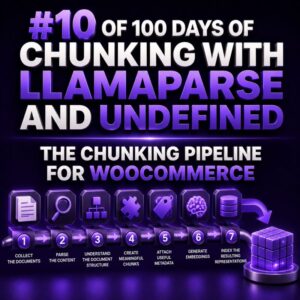
WooCommerce content is rarely organized in the way a retrieval system needs. A single product may contain a short description, a long description, attributes, variations,

A “Recommended for You” component is one of the most visible ways to apply personalization in a WooCommerce store. When implemented well, it helps shoppers

An Algolia record should be shaped around the way shoppers search, filter, sort, and select products—not around the entire WooCommerce product payload. A strong record

A WooCommerce chatbot becomes substantially more useful when it can answer questions from current product data instead of relying on a static prompt or a
Choosing a WordPress search layer for a WooCommerce project is an architectural decision, not just a matter of comparing search widgets. WPSOLR and Relevanssi can

Product views are only valuable when the product page helps shoppers answer three questions quickly: Is this right for me? Can I trust this store?

Recommendation placement is a merchandising decision, not just a widget decision. The same product rule can perform very differently depending on whether a shopper is

Every search box interaction is a signal about what your catalog, navigation, and merchandising are failing to communicate. A customer who searches for “black running

Index product data according to how shoppers search For a WooCommerce agency, indexing every available product field is rarely the best approach. Product records often

WooCommerce variable products require more than a simple product-level search document. A parent product such as a T-shirt may have dozens of variations, each with

WooCommerce product data is structured for storefronts, not for retrieval-augmented generation. A product record contains titles, descriptions, attributes, variations, prices, stock status, categories, taxonomies, and

Your first Elasticsearch query for WooCommerce should answer a specific storefront question, such as: “Which published products match a customer’s search for waterproof hiking boots?”
When building retrieval-augmented systems for WooCommerce stores, three measurements are easy to confuse: characters, tokens, and embeddings. They describe different stages of the content pipeline,

Most WooCommerce stores already produce the behavioral signals needed for product recommendations and other personalized experiences. The data is usually distributed across orders, sessions, product

Before connecting Algolia to a WooCommerce store, it helps to understand the objects and decisions that control how search behaves. Algolia is not a drop-in

Why Connect a Chatbot to WooCommerce Products? A WooCommerce chatbot becomes much more useful when it can work directly with the products, categories, prices, attributes,

A useful WooCommerce conversion rate optimization process is more than changing button colors or adding urgency messages. Agencies need a repeatable checklist that connects customer

Recommendations and personalization are related WooCommerce capabilities, but they solve different problems. A recommendation selects products, content, or offers that may be relevant to a

A WooCommerce store can improve conversion rates when it turns shopper behavior into useful search and merchandising decisions. The goal is not to track every

A useful WooCommerce search experience starts with a deliberate product model. Before importing products into Weaviate, decide which product facts should be searchable, which should
WooCommerce products are rarely organized by one flat label. A product can belong to a hierarchy of categories, have one or more brands, and expose

Retrieval-augmented generation (RAG) adds a retrieval layer between a user’s question and an AI model. Instead of asking a model to rely only on its
In Elasticsearch, choosing between text and keyword fields directly affects how WooCommerce product data is searched, filtered, sorted, and aggregated. The distinction is especially important
Chunk size is one of the highest-impact configuration choices in a retrieval-augmented search system. It determines how much text is embedded and returned as a