
Why Your Search Results Are Relevant — But Still Feel Wrong
A search results page can be technically relevant and still disappoint shoppers. The query may match the product title, description, or attributes, yet the products


A search results page can be technically relevant and still disappoint shoppers. The query may match the product title, description, or attributes, yet the products

WooCommerce chatbots become substantially more useful when they can retrieve products, policies, and operational content by meaning rather than by exact keyword matches. Combining a
For a WooCommerce agency, the choice between WPSOLR and a custom search implementation is primarily an architectural decision. It affects where product data is indexed,

Customer behavior data gives WooCommerce agencies a practical way to improve revenue without relying solely on discounts or increasing traffic. Browsing patterns, product views, searches,

Recommendation quality depends less on adding more products to a carousel and more on choosing logic that matches the store’s catalog, traffic volume, and commercial
The best next-product automation starts with a customer’s most recent purchase, not with a generic “You may also like” block. A WooCommerce store can use

SKU search looks simple until a store contains values such as TSHIRT-BLK-M, TSHIRT BLK M, shirt_blk_m, and supplier codes with leading zeroes. For a WooCommerce

For WooCommerce product search, BM25 is a strong lexical baseline when customers search with meaningful words such as waterproof hiking jacket, USB-C dock, or organic
Retrieval-augmented generation for WooCommerce is often associated with vector embeddings, semantic similarity, and large language models. Those components are valuable, but they do not replace

WooCommerce search quality depends heavily on how product text is analyzed before it is indexed and searched. Two small but important analysis steps are lowercasing

For WooCommerce search, support, and merchandising workflows, chunking should not be the first transformation applied to a document. The reliable order is: parse the source

Why product price needs deliberate recommendation logic Price is one of the most important signals in a WooCommerce catalog, but it should rarely be treated
For a WooCommerce agency, the choice between WPSOLR and a custom WordPress search implementation is primarily a trade-off between delivery speed, search depth, infrastructure control,

Personalization is most effective when it removes friction or makes a relevant offer easier to discover. For WooCommerce agencies, the goal is not to make

Recommendation quality depends on context. A product detail page, cart, checkout, home page, search results page, and post-purchase email each represent a different customer intent.

Cross-sells work best when they answer the shopper’s next question: “What else do I need to use this product?” The challenge for a WooCommerce agency

Why tokenization can quietly damage WooCommerce search When a shopper searches for a product, the visible query is only the starting point. Before Weaviate can

BM25 is a lexical relevance algorithm that scores how well a document matches the terms in a query. In a WooCommerce search application, it can

Hybrid search combines lexical search with semantic vector search so a WooCommerce AI assistant can match both exact product language and user intent. This is
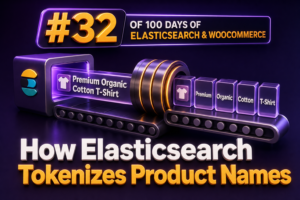
Product-name search quality depends heavily on how Elasticsearch turns text into tokens. A shopper may search for “men’s waterproof trail shoes”, while the catalog contains

A production retrieval system for WooCommerce rarely has one document type or one parsing strategy. Product manuals may arrive as PDFs, supplier catalogs may contain

Product categories are one of the most useful personalization signals available in WooCommerce. They are present on nearly every product, are usually understood by merchandising

WooCommerce shoppers rarely search in the same structured language used by a product catalog. They may enter waterproof hiking boots, boot for hiking, or hiking

WooCommerce search and AI chatbots solve different parts of the product-discovery problem. Keyword search is fast, predictable, and effective when shoppers know the product name,

When shoppers use a different word from the one stored in your WooCommerce catalog, a technically correct search can still return poor results. A customer

AI chatbots can make WooCommerce search more useful when shoppers describe what they need in natural language rather than using exact product names. A customer
For a WooCommerce agency, the choice between WPSOLR and MySQL search is an architectural decision rather than a simple plugin comparison. MySQL search is built
For a small WordPress site, the native search feature may be sufficient. For a WooCommerce catalog with thousands of products, variations, attributes, stock states, and
For a WooCommerce agency, the choice between WPSOLR and ExpertRec is primarily an architectural decision. Both can improve search beyond the default WordPress query, but

A WooCommerce store should not force every visitor through the same experience. A mobile shopper on a slow connection, a returning customer with saved payment
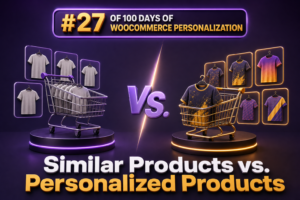
WooCommerce stores often use the terms similar products and personalized products interchangeably, but they describe different recommendation strategies. Similar-product recommendations are based primarily on the

Many WooCommerce stores still present the same product recommendations to every shopper. A visitor viewing a premium running shoe may see a fixed list selected
Product search is often described as a relevance problem, but relevance is not one thing. A shopper searching for black leather boots expects matching products

WooCommerce search quality depends heavily on how product data is represented and weighted. A product title, SKU, brand, category, attributes, and long description do not

WooCommerce search and retrieval-augmented generation solve different parts of the same problem. Keyword search is precise, fast, and easy to constrain with product attributes. RAG

Search quality in a WooCommerce store depends on more than matching product titles against a query. Elasticsearch first converts text into searchable terms, and the

For WooCommerce agencies building search, retrieval, catalog enrichment, or support workflows, LlamaParse and Unstructured can appear to solve the same problem: turning documents into text.

WooCommerce exposes a large amount of product data, but a personalization system does not benefit from receiving every available field. For agencies building product recommendations

Popularity ranking is useful when shoppers want to discover what other customers buy most often, rather than finding a product that matches a highly specific

WooCommerce stores with large or technically detailed catalogs need more than a chatbot that matches keywords to product names. Customers may describe a use case,

Product discovery is a revenue lever, not merely a usability feature. When shoppers quickly find products that match their intent, stores can increase conversion rate,
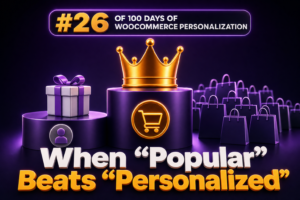
Personalization is not automatically the best merchandising strategy. In WooCommerce, a well-chosen popular-products module can outperform individualized recommendations when a shopper has little usable history,

An upsell is not simply the product with the highest margin or the highest average order value. It is the product that makes sense for
WooCommerce search results often give too much weight to long product descriptions, attributes, and imported metadata. That can make a category name or product name

Why product search needs more than a title field WooCommerce catalogs often contain the information a shopper needs in several places. A product title may

Faceted search and retrieval-augmented generation (RAG) solve different parts of the WooCommerce discovery problem. Facets give shoppers precise controls such as price, brand, size, color,

WooCommerce product search often combines several optional clauses: product title, SKU, categories, attributes, brands, and synonyms. A broad bool query can return products that match

Chunking is not a single step that belongs in every system component. For a WooCommerce agency, the right location depends on what the source document