

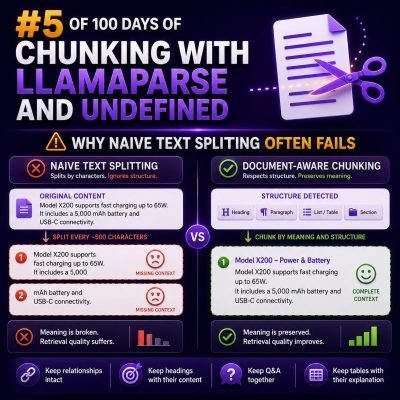
Why Naive Text Splitting Often Fails
Text chunking is easy to underestimate. A WooCommerce agency may take product descriptions, documentation, support articles, and store policies, split them into fixed-size blocks, and assume the resulting content is ready for search, retrieval, or downstream processing. In practice, naive splitting often separates the information customers need from the context that makes it useful.
What Naive Splitting Looks Like
The simplest approach divides text every 500 characters or 1,000 tokens, sometimes with a fixed overlap:
chunk_size = 1000
chunk_overlap = 100</n
This method is predictable, but it knows nothing about headings, paragraphs, product fields, HTML elements, tables, or WooCommerce shortcodes. A split can occur in the middle of a sentence, list item, price rule, or code example.
How Context Gets Lost
Consider a product page containing this content:
Shipping
Free delivery applies to orders over £50 in mainland UK.
Express delivery is available for £8.95.
If the heading is placed in one chunk and the delivery rules in another, a search system may retrieve the rules without clearly identifying that they describe shipping. The same problem occurs when a chunk contains “It is not available for international orders” but the preceding sentence identifying the product or service remains in the previous chunk.
For WooCommerce stores, context can include the product name, variation, category, brand, region, currency, or customer group. A sentence such as “This option adds £12” is not useful unless the surrounding content identifies which option it refers to.
Product Descriptions Are Structured Content
A product page is rarely just a block of prose. It may contain:
- A product title and summary
- Features and technical specifications
- Size, material, and compatibility information
- Variation details and availability notes
- Shipping, returns, and warranty terms
- Frequently asked questions
Splitting the page by character count can combine unrelated sections or separate a label from its value. For example, a chunk containing “Material:” without “100% organic cotton” is effectively incomplete. A better process preserves meaningful sections and attaches stable metadata such as the product ID, SKU, product name, category, language, and URL to every chunk.
HTML, Shortcodes, and Store Markup Need Care
WooCommerce content often includes HTML, Gutenberg blocks, custom fields, and shortcodes. A raw character split can break markup:
[products ids="124,125" columns="2"]
It can also separate a heading from the paragraph it introduces or place a closing HTML tag in a different chunk from its opening tag. The result may be difficult to render, difficult to index, or misleading when used as retrieved context.
Agencies should extract or normalize the content before chunking. Remove presentation-only markup where appropriate, preserve semantic headings and lists, and treat shortcodes as structured elements rather than ordinary text. If a shortcode represents products, resolve the referenced product data or store the shortcode as metadata instead of leaving an incomplete fragment.
Tables and Specifications Are Especially Vulnerable
Technical specifications are often stored in HTML tables or attribute lists:
Voltage | 220–240 V
Power   | 1,200 W
Cable   | 1.8 m
A character-based split may leave a row label in one chunk and its value in another. It may also divide a table halfway through a group of related specifications. Convert tables into readable key-value text, and keep related rows together where possible:
Voltage: 220–240 V
Power: 1,200 W
Cable length: 1.8 m
This format is easier to search and gives each retrieved passage enough context to answer a product question accurately.
Fixed Overlap Does Not Solve Everything
Overlap reduces the chance of losing a sentence at a boundary, but it is not a substitute for semantic boundaries. A 100-token overlap can duplicate part of a product specification while still separating the product name from the specification heading. Large overlaps also increase storage, indexing, and processing costs without guaranteeing better retrieval.
Use overlap selectively. Paragraph-based chunks may need little or no overlap, while long explanatory sections may benefit from a small overlap. The correct amount depends on the content and the questions customers are likely to ask.
A More Reliable Chunking Strategy
A practical WooCommerce pipeline can use a hierarchy of boundaries:
- Separate documents by store, language, URL, and content type.
- Preserve major sections such as product details, specifications, shipping, returns, and FAQs.
- Split oversized sections at paragraphs, list items, or sentences.
- Keep labels with their values and table rows with their headings.
- Add metadata to each chunk, including product ID, SKU, category, section, locale, and source URL.
- Apply a token limit only after the semantic structure has been preserved.
For example, a chunk might contain the following metadata and text:
product_id: 8421
sku: MUG-BLK-12
section: Shipping
locale: en-GB

Free delivery applies to orders over £50 in mainland UK. Express delivery is available for £8.95.
The metadata identifies the source, while the text remains understandable when retrieved independently.
Test Chunks With Real Store Questions
Chunk quality should be measured against actual WooCommerce use cases rather than an arbitrary chunk size. Build a small test set of questions such as:
- Does this product fit a 15-inch laptop?
- How much is express delivery in the UK?
- Is the blue variation available in medium?
- What is the return period for sale items?
- Does this subscription renew automatically?
Inspect whether the retrieved chunk contains the product or policy identity, the relevant condition, and the complete answer. If reviewers must open several adjacent chunks to understand a simple rule, the content boundaries are probably too aggressive.
Operational Checks for Agencies
Before deploying a chunking pipeline, check for duplicated content, orphaned headings, incomplete sentences, broken table rows, missing product identifiers, and mixed-language chunks. Reprocess content whenever templates or WooCommerce fields change, and retain a source reference so editors can trace an indexed passage back to the original page.
Naive splitting is attractive because it is fast to implement, but WooCommerce content carries relationships that character limits cannot see. Preserving those relationships produces smaller, clearer, and more useful chunks for search, support workflows, catalog discovery, and internal agency tools.