

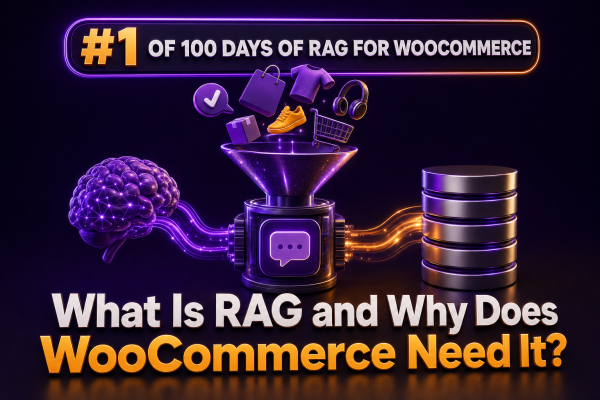
Retrieval-augmented generation (RAG) is an architecture that gives a large language model access to relevant business data at request time. Instead of relying only on information learned during training, the application retrieves matching content from a controlled knowledge source and includes that content in the prompt used to generate the response.
For a WooCommerce store, that knowledge source can include product data, attributes, variation details, shipping rules, refund policies, documentation, order records, and internal agency procedures. The model generates the response, but the retrieved store data provides the facts.
How RAG works
A typical RAG request follows several stages:
- Ingest: Product descriptions, documentation, policies, and other approved data are collected from WooCommerce and connected systems.
- Chunk: Long documents are divided into smaller passages that can be retrieved independently.
- Embed: Each passage is converted into a numerical representation called an embedding.
- Index: Embeddings and metadata are stored in a vector database or another search system.
- Retrieve: A customer or staff question is converted into a search query, and the most relevant passages are selected.
- Generate: The retrieved passages are added to the model context, which then produces an answer.
For example, when a shopper asks, “Will the Alpine jacket fit someone with a 102-centimetre chest?”, the application can retrieve the jacket’s size chart, fit notes, and product attributes before generating a response. The model is not expected to remember the catalogue or invent a measurement conversion from general knowledge.
Why ordinary model knowledge is not enough for WooCommerce
WooCommerce stores contain information that is specific, dynamic, and operationally important. A general-purpose language model usually does not know:
- Which products are currently published, in stock, backordered, or restricted by location.
- Whether a variation is available in a particular size, colour, or subscription interval.
- The store’s current shipping zones, delivery estimates, tax rules, or return windows.
- How product names, attributes, bundles, and custom fields are structured in a specific installation.
- Whether an order is paid, fulfilled, refunded, cancelled, or awaiting manual review.
Sending every store record to the model on every request is expensive, slow, and difficult to control. Fine-tuning is also a poor fit for frequently changing facts. RAG separates the language capability of the model from the store’s changing source data.
WooCommerce use cases for RAG
Product discovery and comparison
A RAG-powered assistant can answer questions across product titles, descriptions, attributes, documentation, and buying guides. It can compare products using retrieved facts rather than relying on keyword matching alone.
For example, a customer could ask for “a waterproof hiking backpack under 150 euros that fits a 16-inch laptop.” Retrieval can combine price, material, capacity, and laptop-fit attributes, then provide an answer linked to the relevant products.
Pre-sale support
Support agents and shoppers can ask questions about compatibility, installation, sizing, ingredients, warranty coverage, and delivery. The retrieval layer should include the relevant product and policy content, with product identifiers and URLs retained as metadata so the response can cite or link to its sources.
Order support
Order-specific assistance requires a different data path from public product search. After authentication and authorization, the application can retrieve a customer’s permitted order information from WooCommerce through the REST API, Store API, or a purpose-built service. The model should receive only the fields needed for the request, such as order status, tracking information, or purchased items.
A customer asking, “Where is order 1842?” should not trigger a broad search over all orders. The application should first verify the customer’s identity and relationship to the order, then retrieve the relevant record directly.
Agency operations and merchant support
Agencies can use RAG over implementation runbooks, plugin documentation, issue histories, deployment notes, and client-specific conventions. This can help teams diagnose recurring problems, identify the correct hook, or find the procedure for safely changing a checkout customization.
RAG architecture for a WooCommerce project
A practical implementation usually has four logical layers:
- WooCommerce data layer: Products, variations, categories, attributes, orders, coupons, and custom fields are accessed through approved APIs, webhooks, database exports, or integration services.
- Knowledge preparation layer: Records are normalized, converted into searchable documents, split into chunks, and enriched with metadata such as product ID, SKU, language, category, visibility, stock state, and update time.
- Retrieval layer: Vector search, keyword search, or a hybrid of both selects relevant content. Filters can exclude unpublished products, old policy versions, or data outside a user’s permissions.
- Generation layer: The application constructs a prompt containing the user’s question, retrieved context, response rules, and any required output format.
A simplified context supplied to a model might look like this:
Source: Product SKU ALP-JKT-01<br>Product: Alpine Jacket<br>Fit: Regular<br>Chest sizes: M 96-101 cm; L 102-107 cm<br>Water resistance: 10,000 mm<br>Last updated: 2025-02-14The prompt should instruct the model to answer from the supplied context, distinguish unavailable information, and avoid claiming that an item is in stock unless a current inventory source confirms it.
Keeping retrieved WooCommerce data current
Freshness is one of the most important design concerns. Product prices, stock, sale dates, shipping rules, and policies can change after content has been indexed.
Use webhooks or scheduled synchronization to update the index when products are created, changed, unpublished, or deleted. Store an external identifier and revision timestamp with every indexed document. When a product changes, update or remove all associated chunks rather than creating an uncontrolled duplicate.
Highly volatile data should often be retrieved directly at request time. Inventory, order status, payment state, and shipment tracking generally should not depend only on a periodically refreshed vector index.
Retrieval quality matters more than model size
A powerful model cannot produce a reliable answer when retrieval returns the wrong product or an outdated policy. WooCommerce teams should evaluate retrieval separately from generation.
- Test exact SKU, product name, and variation searches.
- Test natural-language questions that do not use catalogue terminology.
- Verify that discontinued or hidden products are excluded.
- Check that the correct language, currency, store, and customer segment are applied.
- Measure whether the retrieved passages contain the answer before evaluating the wording of the response.
Hybrid retrieval is often useful. Keyword search handles exact identifiers such as SKUs and order numbers, while vector search handles meaning and paraphrases. Metadata filters reduce false matches and enforce business rules.
Security and privacy requirements
RAG does not automatically make private data safe. WooCommerce agencies should define access controls before connecting order, customer, or internal operational data to a model.
- Separate public catalogue indexes from private customer and order data.
- Authenticate users before retrieving account-specific information.
- Apply authorization filters before context reaches the model.
- Minimize personal data and redact unnecessary fields.
- Log retrieval decisions and model requests without exposing sensitive content in ordinary application logs.
- Review the model provider’s data retention, processing, and regional hosting terms.
Prompt instructions are not an authorization mechanism. A model prompt saying “do not reveal another customer’s order” cannot replace server-side permission checks.
RAG compared with fine-tuning
Fine-tuning changes a model’s behavior or style by training it on examples. It is useful for consistent formatting, classification, or specialized response patterns, but it is not a dependable way to maintain current product prices or order statuses.
RAG supplies current, traceable facts at runtime. Many WooCommerce applications use both approaches: retrieval for store knowledge and fine-tuning or carefully designed examples for tone, structure, and tool-use behavior.
A sensible first implementation
Start with a narrowly defined, read-only use case such as product questions for a single store and language. Index published product content, attributes, categories, and approved buying guides. Preserve product IDs and URLs in metadata, add stock and price checks outside the language model, and require the assistant to state when the available data does not answer a question.
Once retrieval quality and permission boundaries are proven, extend the system to policy content, agency documentation, and authenticated order support. Keep actions such as refunds, cancellations, stock changes, and address updates behind explicit application tools with validation and confirmation; retrieved text alone should never authorize a transaction.