

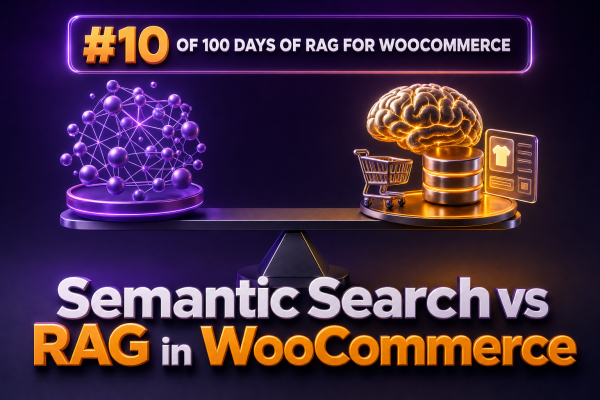
Semantic search and retrieval-augmented generation (RAG) are related, but they solve different problems in a WooCommerce implementation. Semantic search improves how products, documentation, and support content are retrieved. RAG uses retrieved content to produce a grounded answer, recommendation, or workflow result.
For agencies, the distinction affects architecture, cost, testing, and client expectations. A product finder may only need semantic retrieval. A store assistant that explains compatibility, checks policies, and cites product information usually needs RAG, often combined with structured WooCommerce queries.
What semantic search does
Traditional keyword search looks for matching terms. A query such as “waterproof jacket for winter cycling” may miss a product described as a “weather-resistant commuter shell” if the product does not contain the exact words “winter cycling.”
Semantic search represents the query and indexed content as vectors, commonly called embeddings. It then retrieves content based on semantic similarity rather than exact word overlap. In WooCommerce, the indexed content might include:
- Product titles and long descriptions
- Short descriptions and product attributes
- Category and brand descriptions
- Variation-level information such as size, color, or material
- Help center articles, buying guides, and shipping documentation
- Customer support resolutions and internal product notes, where appropriate
A semantic search service returns matching records, usually with a relevance score and metadata. It does not inherently explain the results, verify live stock, apply business rules, or answer the customer in natural language.
What RAG adds
RAG combines retrieval with generation. The system first retrieves relevant content and then supplies that content to a language model as context for an answer. A typical WooCommerce RAG request follows this sequence:
- Accept a question such as “Which replacement filter fits the 2022 AirPure 300?”
- Classify the request and extract useful filters, such as product type, model, and year.
- Retrieve relevant product records, compatibility documents, and policy content.
- Pass the selected context to a language model with instructions about accuracy, citations, and unsupported claims.
- Return an answer, product links, or a structured action for the storefront.
RAG can make the response easier to use, but it does not make inaccurate source data accurate. If a product description contains an obsolete compatibility claim, the generated answer can repeat it confidently. Retrieval quality and source governance therefore remain critical.
Semantic search versus RAG in a WooCommerce stack
Semantic search is primarily a retrieval capability. RAG is an application pattern built on retrieval. They can be compared across common agency requirements:
- Product discovery: Semantic search is often sufficient for finding relevant products. RAG is useful when the shopper needs an explanation or comparison.
- Natural-language answers: RAG is the better fit because it can synthesize several retrieved documents into a response.
- Live price and stock: Neither embeddings nor generated text should be treated as the source of truth. Query WooCommerce or the store’s commerce services at request time.
- Performance and cost: Semantic search usually has lower latency and inference cost. RAG adds prompt construction, model latency, output validation, and monitoring.
- Predictability: Search results are easier to test deterministically. Generated responses require additional tests for factuality, citations, refusal behavior, and formatting.
- Content freshness: Both approaches depend on current indexes, but RAG can make stale content more noticeable because it turns retrieved records into authoritative-sounding prose.
Use structured filters for commerce facts
A common implementation mistake is embedding every product field and asking the language model to infer all constraints. Vector similarity is not a reliable replacement for exact commerce filters.
Use structured queries for facts such as:
- Stock status and available quantity
- Current price, sale price, currency, and tax handling
- Product visibility and catalog status
- Category, brand, attribute, and variation values
- Minimum or maximum price
- Shipping region and delivery restrictions
For example, a query for “red waterproof hiking boots under $150 in size nine” can be processed as a hybrid request. Semantic retrieval can identify products matching the concepts “waterproof hiking boots,” while structured filters enforce the color, size, price, and availability requirements. The final answer should use current product data returned by WooCommerce or the store’s product service.
A practical hybrid architecture
A production WooCommerce implementation commonly separates catalog retrieval from conversational generation:
- Index content: Create embeddings for product copy, buying guides, and support documents. Store product IDs, variation IDs, URLs, language, product status, and relevant taxonomy metadata alongside each vector.
- Normalize the request: Identify intent, product terms, attributes, compatibility identifiers, and numeric constraints before searching.
- Run hybrid retrieval: Combine keyword or taxonomy filtering with semantic similarity. Apply hard filters before generation whenever possible.
- Fetch authoritative records: Recheck price, stock, purchasability, and variation details from the current WooCommerce data source.
- Build bounded context: Include only the product and document fields needed to answer the request. Preserve source URLs or IDs for citations and auditing.
- Generate a constrained response: Instruct the model not to invent specifications, availability, delivery dates, or compatibility claims that are absent from the supplied context.
- Validate the output: Check links, product IDs, prices, and structured actions before returning the response to the storefront.
Example: product search without generation
A category landing page might use semantic search to improve results for a query such as “quiet office chair for a small room.” The service can return product IDs ordered by relevance. The WooCommerce frontend then renders the products using current price, image, variation, and stock data.
This approach is appropriate when the interface already provides filters and product cards. It avoids unnecessary model calls and keeps the result format predictable. The search index should still exclude drafts, private products, and records that are no longer available in the catalog.
Example: RAG for a buying assistant
A buying assistant might receive: “I need a coffee grinder for espresso, but I want something easy to clean.” Semantic retrieval can find grinder products, cleaning guides, and comparison content. The RAG layer can then explain which products match the stated priorities and link to the relevant product pages.
The prompt should distinguish evidence types. Product specifications should come from product records. Cleaning advice may come from a manufacturer guide or store documentation. Current price and availability should be fetched separately. If no source confirms that a grinder is suitable for a particular espresso machine, the assistant should ask for the machine model or state that compatibility is unverified.
Agency implementation and testing considerations
Define the boundary between retrieval and generation before development begins. A useful contract is that retrieval returns evidence and identifiers, while generation turns approved evidence into customer-facing language. This makes it easier to replace a model, inspect failures, and keep commerce operations independent of the conversational layer.
Test semantic search with synonym, spelling, and paraphrase cases. Test RAG with questions that require multiple sources, ambiguous product names, missing information, contradictory documents, and stale inventory. Include adversarial prompts that attempt to make the assistant ignore price limits or disclose private product notes.
Track retrieval metrics such as recall at a chosen cutoff, filtered-result accuracy, and stale-index rate. For generated answers, track citation coverage, unsupported-claim rate, refusal accuracy, response latency, and conversion-related outcomes. Log product and document identifiers rather than sending unnecessary customer or order data to the model.
Choosing the right capability
Choose semantic search when the requirement is better matching, related-product discovery, or faster access to existing catalog and help content. Choose RAG when customers need a grounded explanation, a comparison across sources, or a conversational interface.
For most serious WooCommerce projects, the practical answer is not semantic search versus RAG. It is semantic search as one retrieval layer inside a broader RAG workflow, combined with exact WooCommerce queries for live transactional facts and explicit business rules for what the assistant may say or do.