

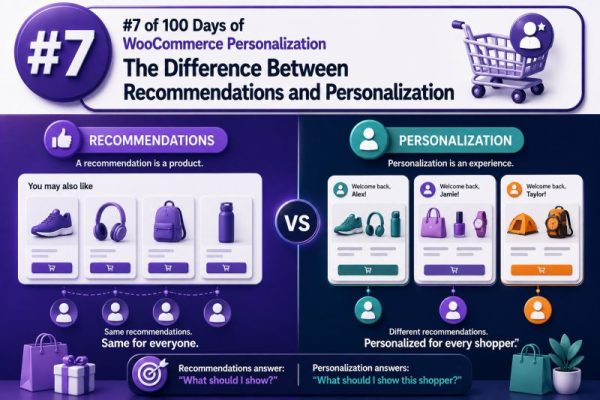
Personalization changes more than the products a shopper sees. It can alter how a customer discovers a store, evaluates products, completes checkout, and returns for a subsequent purchase. For WooCommerce agencies, the most effective implementations map personalization to each stage of the shopping journey rather than treating it as a single recommendation widget.
Map personalization to the customer journey
A useful journey model includes five stages:
- Discovery: The shopper arrives through search, advertising, social media, email, or a referral.
- Evaluation: The shopper compares products, reads reviews, checks availability, and considers delivery or returns.
- Conversion: The shopper adds items to the cart and completes checkout.
- Post-purchase: The store supports delivery, product use, replenishment, and returns.
- Retention: The store gives the customer relevant reasons to return without relying on indiscriminate promotions.
The same customer may need different content at each stage. A first-time visitor may benefit from category guidance, while a returning customer may need a replenishment reminder or a complementary product. Personalization should respond to the customer’s current intent, not only to historical behavior.
Discovery: reduce the distance to a relevant category
At the discovery stage, the shopper often has limited context. Personalization can make the first interaction more useful by reflecting the visitor’s campaign, referral source, location, device, or previously selected preferences.
For example, a WooCommerce store selling professional lighting could direct visitors from a photography campaign to a photography-focused landing page. A visitor from a commercial-installation campaign might instead see products, case studies, and specifications aimed at contractors. The underlying catalog remains the same, but the entry point and merchandising priorities match the visitor’s likely task.
Agencies can implement this with campaign parameters, landing-page templates, product-category rules, and carefully scoped cookies or server-side session data. Avoid changing the entire site based on a single click. A campaign source is a useful starting signal, but it should not permanently define the customer’s experience.
Evaluation: make comparison easier
During evaluation, relevance means helping the customer make a confident decision. Useful personalization patterns include:
- Showing recently viewed products so the shopper can resume research.
- Prioritizing products that match a selected use case, size, compatibility requirement, or budget.
- Displaying related accessories that are genuinely required or commonly used with the viewed product.
- Presenting region-specific delivery estimates, taxes, currencies, or availability where the store has reliable data.
- Adjusting educational content based on whether the customer appears to be a beginner, repeat buyer, or trade purchaser.
Product recommendations should use strong relationships first. Explicit relationships such as upsells, cross-sells, grouped products, and compatible-product attributes are usually easier to explain and test than an opaque algorithm. Behavioral recommendations can supplement these relationships when the store has enough traffic and clean event data.
Conversion: remove friction without creating pressure
Personalization at checkout should reduce uncertainty rather than manipulate urgency. A returning customer might see saved addresses, preferred payment methods, or a reminder of a previously selected delivery option, subject to the payment provider’s security requirements and the customer’s consent.
Cart personalization can also be practical. If a customer adds a camera body, the cart can suggest a compatible memory card or battery. If the customer adds a subscription product, the store can explain renewal timing and cancellation terms before payment. These offers should be based on product compatibility and customer value, not simply on the highest possible order total.
For WooCommerce implementations, test personalized cart blocks, mini-cart recommendations, and checkout messaging independently. A custom checkout extension should not slow down checkout or interfere with payment gateway validation, tax calculation, stock checks, or order creation. Dynamic content must also remain usable for customers who block non-essential cookies or use assistive technologies.
Post-purchase: continue the relationship with useful information
The order creates a stronger signal than many pre-purchase interactions. After purchase, the store can personalize communications around fulfillment and product use:
- Send setup or care instructions that match the purchased product.
- Recommend compatible items only after confirming that they are not already included in the order.
- Provide delivery updates based on the actual order and shipping method.
- Request a review after a reasonable product-use period rather than immediately after payment.
- Offer replenishment reminders based on expected usage intervals, with controls for changing or stopping reminders.
WooCommerce order status, product data, subscription records, and customer preferences can support these workflows. Agencies should define which system owns each field and synchronize only the data required by the email, CRM, support, or analytics platform.
Retention: recognize intent without over-personalizing
Retention personalization works best when it respects the reason a customer is returning. A customer who repeatedly buys consumables may need a simple reorder path. A customer who has browsed several product families may need comparison content. A wholesale buyer may need account-specific pricing, minimum quantities, payment terms, or a frequently ordered product list.
Segment customers using meaningful business signals such as purchase frequency, product category, subscription status, account role, or support history. Do not assume that every customer wants discounts. Sending a discount to a customer who was already ready to buy can reduce margin without improving retention.
Use a signal hierarchy
Not all personalization signals are equally reliable. A practical hierarchy is:
- Explicit preferences: Information the customer deliberately provides, such as size, trade status, preferred categories, or communication choices.
- Transactional data: Completed orders, subscriptions, returns, and product ownership.
- Current-session behavior: Search terms, filters, viewed products, and cart contents.
- Contextual data: Device type, language, location, campaign source, and time of visit.
- Inferred preferences: Predictions derived from browsing or similarity models.
Use the strongest available signal and provide a sensible default when signals conflict. For example, a customer’s explicit preference for a product size should generally take precedence over an inferred preference from previous browsing.
Design the data and privacy layer first
Personalization depends on data, but collecting more data does not automatically produce better experiences. Document the purpose of each signal, its retention period, its source, and the systems that receive it. Obtain consent where required for analytics, advertising, profiling, or non-essential cookies, and provide a way for customers to change their choices.
Do not expose sensitive customer attributes in front-end personalization rules or URL parameters. Keep customer-specific pricing, eligibility, and account data server-side. Cache carefully: a publicly cached page must not display one customer’s name, cart, account status, or personalized price to another visitor.
Agencies should also include personalization in accessibility, security, and performance reviews. Dynamic recommendations need meaningful labels, keyboard access, and a useful fallback. Personalization scripts should be deferred or loaded only when necessary, and the store should remain functional if a third-party recommendation or tracking service is unavailable.
Measure journey outcomes, not just clicks
Measure each personalization rule against the journey stage it is intended to improve. Useful metrics include:
- Discovery: category engagement, search refinement, and landing-page progression.
- Evaluation: product-detail engagement, comparison usage, add-to-cart rate, and return-to-listing rate.
- Conversion: checkout completion, average order value, margin per order, and payment failure rate.
- Post-purchase: support contacts, review completion, repeat purchase interval, and return rate.
- Retention: reorder rate, subscription retention, customer lifetime value, and unsubscribe rate.
Use holdout groups or controlled A/B tests where possible. Compare personalized experiences with a relevant baseline, and evaluate incremental revenue alongside margin, refunds, returns, page speed, and customer complaints. A recommendation module that increases average order value but also increases returns may not be creating business value.
Build a maintainable WooCommerce implementation
Start with a small number of high-confidence use cases, such as compatible accessories, recently viewed products, reorder reminders, or trade-account merchandising. Define the rule, eligible products, fallback behavior, consent requirements, and success metric before development begins.
Keep catalog relationships in WooCommerce product data where possible, rather than embedding business logic in theme templates. Use hooks, blocks, or a dedicated extension to isolate personalization from the theme. Log recommendation decisions in a privacy-conscious way so the team can diagnose why a customer saw an offer. Test logged-in and guest sessions, cache layers, multilingual stores, tax settings, subscriptions, refunds, and stock changes before release.
A journey-based approach gives agencies a clearer way to prioritize personalization: help the visitor find the right category, help the shopper evaluate confidently, remove conversion friction, support successful product use, and make the next purchase easier when there is a genuine reason to return.