

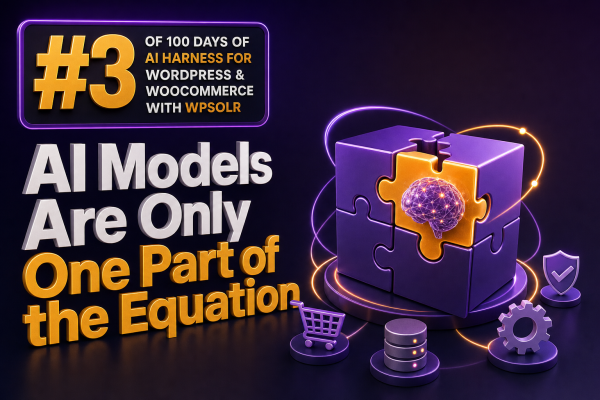
Choosing an AI model is important, but it is rarely the part that determines whether an AI feature succeeds in a WooCommerce store. The model generates an answer from the context it receives. Search quality, product data, business rules, permissions, prompts, tool integrations, evaluation, and monitoring determine whether that answer is useful and safe.
For agencies, this distinction matters. A more expensive model cannot reliably compensate for incomplete product attributes, stale inventory data, weak retrieval, or an integration that allows the model to invent order information. The practical goal is to design an AI harness around the model rather than treating the model as the entire solution.
The AI equation has several parts
A production AI feature usually combines the following components:
- Model: Generates text, classifies requests, extracts structured data, or selects an action.
- Data: Product titles, descriptions, attributes, documentation, policies, orders, and other business content.
- Retrieval: Finds the most relevant content for the current request.
- Instructions: Defines the model’s role, response format, limitations, and tone.
- Tools and integrations: Allow controlled access to WooCommerce, WordPress, shipping systems, CRM platforms, or support software.
- Application logic: Validates inputs, enforces permissions, handles errors, and decides when a model may act.
- Evaluation and observability: Measures quality, latency, cost, failures, and business outcomes.
A useful mental model is:
AI result = model capability × context quality × application controls
If any factor is weak, the overall result suffers. A strong model supplied with irrelevant product content can still recommend the wrong product. A well-indexed catalog can still produce unsafe results if the application exposes unrestricted order or customer data.
Why model selection is not enough
Suppose a shopper asks, “Which waterproof jacket is suitable for winter cycling and available in medium?” The model cannot answer reliably unless the system can retrieve products with relevant descriptions, material information, intended use, size availability, and current stock.
Increasing the model’s temperature or switching to a larger model does not create missing product facts. It may produce more fluent text, but fluency is not evidence of accuracy. The application must supply authoritative context and define what happens when the required information is unavailable.
The same principle applies to an internal support assistant. If the assistant is expected to explain refund eligibility, it needs the current refund policy and, where appropriate, verified order data. It should not infer policy from an old blog post or guess an order status from a conversation.
WordPress and WooCommerce data are part of the system
AI features often depend on content that was not originally created for machine retrieval. Product data may contain short descriptions, inconsistent attributes, missing dimensions, duplicated specifications, or important information hidden in PDFs and page builders.
Before integrating a model, agencies should inspect the content that will be indexed and retrieved:
- Are product titles specific enough to distinguish similar products?
- Are attributes stored consistently, or are they embedded in free-form descriptions?
- Are variations and variation-level prices or stock included where they matter?
- Are discontinued products excluded or clearly marked?
- Are shipping, returns, warranty, and compliance policies current?
- Can private, draft, customer-specific, or administrative content enter the retrieval index?
WPSOLR can be part of this retrieval layer by making WordPress and WooCommerce content searchable and by providing a way to tune how content is indexed and matched. The exact configuration should reflect the store’s catalog, taxonomies, custom fields, language requirements, and search infrastructure. Retrieval should be tested with real shopper and support queries rather than assumed to be correct because indexing completed successfully.
Retrieval quality directly affects answer quality
Retrieval-augmented generation, commonly called RAG, gives a model selected content along with the user’s request. A simplified flow looks like this:
- Receive and normalize the request.
- Search indexed WordPress or WooCommerce content.
- Filter results according to visibility, language, store, and user permissions.
- Pass the most relevant, current records to the model.
- Instruct the model to answer only from the supplied context when factual claims are required.
- Validate the response or route it to a human when confidence or policy requirements are not met.
For example, a product assistant might receive context such as:
{
  "product": "Alpine Winter Jacket",
  "attributes": {
    "waterproof_rating": "20,000 mm",
    "insulation": "synthetic",
    "size": "M"
  },
  "availability": "in stock",
  "source_url": "https://example.com/product/alpine-winter-jacket"
}
The model can then explain the product using those fields. It should not claim that the jacket is suitable for a particular temperature range unless that information is present in the retrieved content or supplied by an approved business rule.
Separate search from business actions
Reading information and changing information are different risk levels. An AI feature that summarizes product descriptions has a smaller operational impact than one that cancels orders, changes subscriptions, issues refunds, or edits catalog content.
A safer architecture keeps the model away from unrestricted WordPress and WooCommerce access. Instead, expose narrow application functions with explicit validation. For example, an order-status tool might accept an authenticated order identifier, verify that the current user is entitled to view it, retrieve the status from WooCommerce, and return a limited response. The model chooses or formats the request; the application remains responsible for authorization and execution.
For write operations, consider requiring confirmation and recording an audit event:
- Show the proposed action and affected order or product.
- Confirm that the user has permission to perform it.
- Validate the parameters on the server.
- Require explicit user confirmation for irreversible or financial actions.
- Log the request, result, actor, and failure state without exposing unnecessary personal data.
Prompts are instructions, not security controls
A system prompt can tell an assistant not to reveal private information, but a prompt cannot replace access control. Permissions must be enforced before sensitive content is added to the model context and again before an action is executed.
Prompts are still important for defining behavior. A WooCommerce product assistant might be instructed to:
- Use only the supplied catalog context for product facts.
- Distinguish between confirmed availability and unknown availability.
- Ask a clarifying question when size, region, budget, or use case is missing.
- Include a product link only when it is present in the retrieved record.
- State when the catalog does not contain enough information.
These instructions should be tested against adversarial and ordinary requests. Prompt injection can occur in user input or in indexed content, so retrieved text should be treated as untrusted data rather than as instructions with authority over the application.
Build an evaluation set before changing models
Agencies need repeatable tests to determine whether a change improves the system. Create a small evaluation set from real store queries and include expected behavior, not just expected wording.
A useful set might contain:
- Exact product searches.
- Attribute combinations such as color, size, material, and price.
- Queries using synonyms and misspellings.
- Questions where no matching product exists.
- Requests involving out-of-stock or discontinued products.
- Policy questions requiring current documentation.
- Requests for private order information.
- Attempts to trigger unauthorized actions.
Measure retrieval relevance separately from response quality. If the correct product is not in the retrieved results, changing the model is unlikely to fix the root cause. Also track unsupported claims, incorrect availability statements, citation or link accuracy, latency, token usage, and escalation rate.
A practical agency workflow
- Define the job: Decide whether the feature searches, summarizes, classifies, recommends, or executes an action.
- Map authoritative sources: Identify which WordPress posts, WooCommerce fields, policies, and external systems contain the facts.
- Prepare the content: Normalize attributes, remove obsolete records, and establish ownership for updates.
- Configure retrieval: Use WPSOLR and the surrounding search infrastructure to index the required content and test relevance with representative queries.
- Constrain the model: Provide focused context, structured instructions, and a defined response schema where possible.
- Protect operations: Keep authentication, authorization, validation, and transaction handling in application code.
- Evaluate continuously: Run a fixed test set whenever prompts, indexes, model providers, or WooCommerce integrations change.
- Monitor production: Review failures, user feedback, costs, latency, and content freshness.
The model is a replaceable component
When the surrounding system is well designed, the model can be changed without rebuilding the entire feature. Agencies can compare providers or model sizes against the same retrieval data, tools, prompts, and evaluation set. This makes decisions more practical: use a smaller model for classification or structured extraction, and reserve a more capable model for complex explanations or multi-step reasoning when the measured benefit justifies the cost.
The durable asset is not the model name. It is the tested combination of clean WooCommerce data, reliable retrieval, controlled integrations, clear failure behavior, and operational feedback. That is the foundation of an AI harness that can support production WordPress projects.