

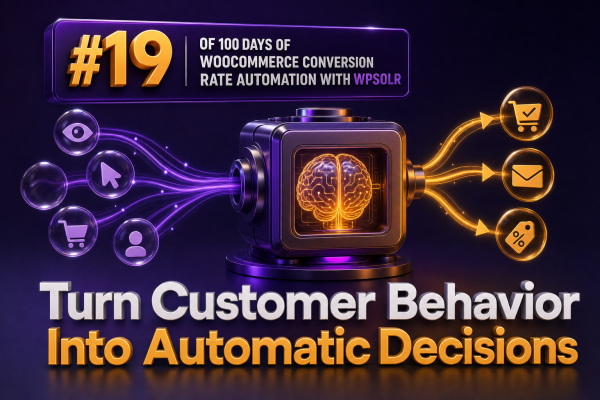
WooCommerce stores generate useful behavioral signals every day: search terms, zero-result searches, viewed products, filter usage, add-to-cart events, purchases, and abandoned sessions. The conversion opportunity is not simply collecting those signals. It is using them to make the next relevant decision automatically.
WPSOLR can provide the search and discovery layer for those decisions, while WooCommerce, analytics tools, and custom automation code can supply the surrounding customer and order data. The practical goal is a controlled feedback loop: observe behavior, classify intent, select an action, measure the result, and improve the rule.
Start with observable customer signals
Choose signals that can be captured consistently and mapped to a business decision. For a WooCommerce agency, the most useful starting signals usually include:
- Search intent: the query entered, selected filters, clicked result, and whether the search returned products.
- Catalog friction: zero-result searches, repeated searches, excessive pagination, and filter combinations that produce no usable products.
- Commercial intent: product views, variant selection, add-to-cart events, checkout starts, and completed purchases.
- Customer context: logged-in status, customer role, previous orders, geographic region, and device type, where permitted by the site’s privacy policy.
- Operational context: stock status, product margin, fulfillment location, active promotions, and category availability.
Do not begin with every possible event. A small set of reliable signals is more valuable than a large event stream that cannot be interpreted or tested.
Translate behavior into explicit rules
An automatic decision should be written as a condition and an action. This makes it possible to review the logic with merchants, implement it consistently, and measure whether it improves conversion.
For example, a search rule might be expressed as:
IF a shopper searches for an exact product model<br>AND the query returns one or more in-stock products<br>THEN prioritize exact model matches above broad category matchesA merchandising rule might be:
IF a query contains a high-intent attribute such as