
100 Days of AI ChatBot for WooCommerce guides for WordPress & WooCommerce

How AI Chatbots Understand Product Intent

For a WooCommerce chatbot, understanding product intent means identifying what a shopper is trying to accomplish—not merely matching the words in a message. A request such as “I need waterproof shoes for winter under $150” contains several signals: a product category, a use case, a functional attribute, a seasonal requirement, and a price constraint. Reliable intent detection converts that natural-language request into structured information that the chatbot can use to search the catalog, ask a useful follow-up question, and recommend products that are actually purchasable. What Product Intent Contains Product intent is usually composed of multiple parts rather than one fixed label. A practical WooCommerce implementation should extract the following elements: Task: The shopper may want to find, compare, filter, configure, reorder, track, or troubleshoot
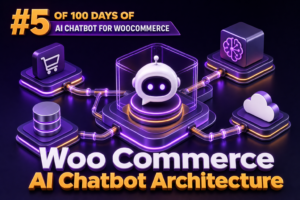
WooCommerce AI Chatbot Architecture

A production WooCommerce AI chatbot is not simply a chat interface connected directly to the store database. It is an application layer that coordinates conversation state, product and order data, WooCommerce actions, access control, and external AI services. A sound architecture keeps those responsibilities separate so agencies can support multiple stores, change AI providers, and enforce predictable business rules. Reference architecture A practical implementation can be divided into six layers: Chat client: The storefront widget, customer account interface, or support dashboard that collects messages and displays responses. Conversation API: An authenticated endpoint that validates requests, identifies the customer or guest session, applies rate limits, and orchestrates the response. AI orchestration: The service that manages prompts, conversation history, tool selection, retrieval, model calls, and response validation.

Building Your First WooCommerce AI Chatbot

A WooCommerce AI chatbot should begin as a narrowly scoped commerce assistant, not as an unrestricted agent with access to every store operation. The first production version should answer a small set of high-value questions, retrieve current catalog information, and hand off sensitive or ambiguous requests to a human. This approach gives an agency measurable results without introducing unnecessary order, privacy, or fulfillment risk. Define the chatbot’s first release Before selecting a model or writing an integration, define the exact jobs the chatbot is allowed to perform. A practical first release usually includes: Answering product questions using current product and variation data. Helping shoppers find products based on attributes such as size, color, price, or use case. Explaining shipping, returns, payment, and store policies from

How AI Chatbots Change WooCommerce Shopping

AI chatbots are changing WooCommerce shopping by moving customers from keyword-based browsing to guided, conversational buying journeys. Instead of asking shoppers to navigate categories, filters, product pages, and support articles independently, a chatbot can interpret intent, retrieve store data, compare suitable products, and help complete the next step. For WooCommerce agencies, the important distinction is between a chatbot that only generates text and one that can safely use real store data. A production shopping assistant should combine a language model with product catalogs, inventory, shipping rules, customer context, and controlled WooCommerce actions. How conversational shopping differs from traditional WooCommerce browsing Traditional shopping usually follows a path such as category page, filters, product detail, cart, and checkout. This works well when shoppers know the product name

AI Chatbot vs Traditional WooCommerce Search

WooCommerce agencies often treat conversational shopping and site search as interchangeable because both help customers find products. They solve different problems, however. Traditional search is optimized for fast retrieval from a product catalog, while an AI chatbot is designed to interpret intent, ask follow-up questions, explain options, and support a longer buying journey. How traditional WooCommerce search works A conventional WooCommerce search typically matches a query against product titles, descriptions, SKUs, attributes, categories, tags, and sometimes custom fields. Depending on the implementation, it may use WordPress database queries, a search plugin, or an external index such as Elasticsearch or OpenSearch. For example, a customer searching for men's waterproof hiking boots under $150 may receive results based on indexed words such as men's, waterproof, and hiking.

What Is an AI Chatbot for WooCommerce?

An AI chatbot for WooCommerce is a conversational software system that helps shoppers interact with an online store using natural-language messages. It can answer product questions, explain shipping and returns, recommend products, check order status, and hand complex conversations to a human agent. Unlike a basic live-chat widget or a fixed decision tree, an AI chatbot can interpret different ways of asking the same question and use store data to produce a relevant response. For a WooCommerce site, that data may include products, variations, prices, stock status, attributes, orders, customer accounts, shipping zones, payment methods, and store policies. How an AI Chatbot Fits Into WooCommerce A production chatbot normally sits between the customer-facing chat interface and the store’s operational systems. A typical implementation includes four