

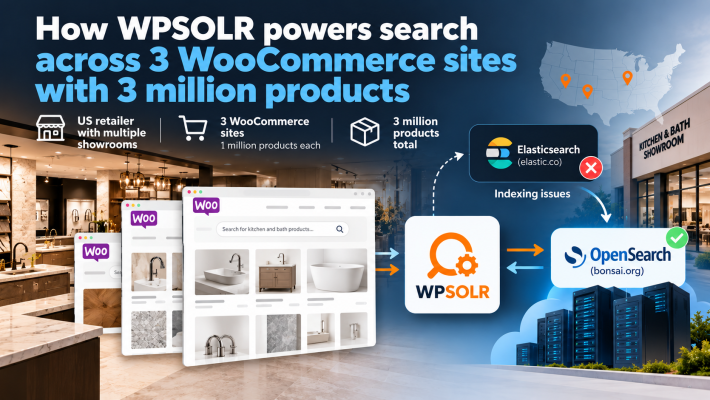
The customer: A US retailer with multiple showrooms
This customer is a US kitchen and bath retailer combining multiple physical showrooms with a substantial e-commerce business.
Its online catalog spans three WooCommerce sites, each containing approximately one million products — around 3 million products in total.
At this scale, choosing the right search infrastructure is critical. The retailer needed a search solution that could accommodate its large catalogs while integrating with its existing WooCommerce environment.
The challenge: Elasticsearch indexing issues
The customer initially used Elasticsearch through Elastic Cloud (elastic.co) to power product search.
However, indexing issues led us to reconsider the search infrastructure.
For a retailer managing millions of products across multiple sites, indexing is fundamental to keeping product data available to shoppers. We needed an alternative search engine without having to rebuild the entire WooCommerce search integration.
The solution: Switching from Elasticsearch to OpenSearch with WPSOLR
WPSOLR recommended moving to OpenSearch hosted by Bonsai (bonsai.org).
One of WPSOLR’s key strengths is its ability to switch between supported search engines without requiring the entire WooCommerce search integration to be rebuilt from scratch.
Instead of starting over with a new search integration, the customer could use WPSOLR to connect its WooCommerce catalogs to a different search engine.
The architecture combines three components:
- WooCommerce: Manages the product catalogs across the three sites.
- WPSOLR: Provides the integration between WooCommerce and the search engine.
- Bonsai managed OpenSearch: Provides the underlying search infrastructure.
The customer’s agency handles the storefront integration, keeping the presentation layer separate from the search engine.
Switching engines may still require reindexing, configuration changes and validation, but WPSOLR provides a reusable integration layer that makes changing the underlying search technology more straightforward.
The architecture at a glance
| Component | Details |
|---|---|
| Business | US kitchen and bath retailer with multiple showrooms |
| E-commerce platform | WooCommerce |
| Number of sites | 3 |
| Products per site | Approximately 1 million |
| Total catalog | Approximately 3 million products |
| Initial search engine | Elasticsearch on Elastic Cloud |
| Challenge | Indexing issues |
| New search engine | OpenSearch hosted by Bonsai |
| Search integration | WPSOLR |
| Managed infrastructure cost | Approximately $700 per month |
| Storefront integration | Managed by the customer’s agency |
Why WPSOLR matters
Search infrastructure requirements can change as an e-commerce business grows. A search engine that initially fits a project may later present operational challenges.
With WPSOLR, the search integration does not have to be tightly coupled to a single search engine.
In this project, when the customer encountered indexing issues with Elasticsearch, WPSOLR provided a path to an alternative based on OpenSearch.
This flexibility is particularly valuable for large WooCommerce deployments, where rebuilding an entire search integration can add unnecessary development work and migration complexity.
WPSOLR gives WooCommerce businesses the freedom to change their search engine as their needs evolve, while retaining a reusable integration layer.
The takeaway
3 WooCommerce sites. Approximately 3 million products. Two search engines. One flexible integration layer.
This customer project illustrates how WPSOLR helps large WooCommerce businesses adapt their search infrastructure without having to start their integration from scratch.